

Current Initiatives
The Provost's Office has a series of initiatives for the 2025-26 academic year:
Rebalancing Workload
The Rebalancing Faculty Workload Committee (RFWC) was assembled by President Cassidy and Provost Harte in the Spring of 2024 to craft a path forward for renewed excellence at Bryn Mawr College in teaching, scholarship, and service that robustly considers the complex demands on the time and energy of its faculty. The Committee completed a “Proposal to Rebalance Faculty Workload” in May 2025 that was shared with President Cadge, who shared it with the Board of Trustees. Central to the plan is a 2-2 course load for tenured and tenure-track faculty and an expansion of the faculty to ensure that our curriculum is properly staffed. In the 2025-26 academic year, with a newly elected RFWC, the Committee on Academic Priorities and the President will collaborate to plan the beginnings of the 2-2 course load implementation.
Academic Collaboration in the Bi-Co Grants Program
Bryn Mawr and Haverford Colleges invite academic departments, programs, and cross-unit collaborative groups to propose achievable, innovative pilot projects that promise meaningful outcomes for students, support faculty innovation, and enhance the academic experience across both campuses. We seek big new ideas that will drive academic creativity and continue to ensure that the Bi-Co is more than the sum of its parts.
Don't miss opportunities to apply for grants to enhance strategic innovation and sustainability initiatives.
Bryn Mawr and Haverford Colleges
Big Idea for Academic Collaboration in the Bi-Co
Pilot Grants
Issued by: President Wendy Cadge & President Wendy Raymond
Deadline for Submission: October 28 (Round1); December 19 (Round 2)
Funding Period: Jan 15 - August 1, 2026
Bryn Mawr and Haverford Colleges invite academic departments, programs, and cross-unit collaborative groups to propose achievable, innovative pilot projects that promise meaningful outcomes for students, support faculty innovation, and enhance the academic experience across both campuses. We seek big new ideas that will drive academic creativity and continue to ensure that the Bi-Co is more than the sum of its parts. Our goal is to spark initiatives that:
- Strengthen the academic experience and foster intellectual innovation across both campuses;
- Promote sustained collaboration across and between departments, disciplines, and campuses;
- Contribute to the intellectual environment, inquiry, and knowledge that enable undergraduates to thrive.
- Position the Bi-Co nationally as a place big ideas are nurtured and grown into more than the sum of its parts
Proposals may focus on either exploring or planning implementation of innovative, cross-college initiatives.
- Exploration Projects offer faculty opportunities to explore fields and collaborations that do not yet exist at Bryn Mawr or Haverford through shared seminars, speakers, research about similar efforts at other colleges and universities, or other exploratory processes. We expect these projects to result in proposals for next steps including timelines and the budgets required to meet them.
- Planning Projects offer faculty the opportunity to extend and further develop existing collaborations that strengthen and enrich collaborations across Haverford and Bryn Mawr. Such projects might include planning for shared curriculum, developing a structure for shared research experiences for students at both campuses, building a minor into a major or intellectual collaborations in other ways. Proposals should include a clear roadmap including timelines and the budgets required to bring these initiatives to scale.
All projects should leverage the distinctive strengths of both institutions, foster collaboration across departments and disciplines, and contribute to the advancement of the colleges’ missions and academic distinction
Faculty and staff in all academic departments, programs, and inter-unit initiatives within the Bi-Co are eligible to apply. All proposals must include at least one faculty member and one collaborator each from Haverford and Bryn Mawr.
Proposals should:
- Clearly Identify an Academic Need or Opportunity - and briefly explain that need or opportunity.
- Foster Cross-College Collaboration — Leverage resources, expertise, and opportunities across both Haverford and Bryn Mawr.
- Define Clear, Measurable Outcomes — Specify the tangible benefits for students or the academic program and describe how success will be assessed.
- Be Achievable Within the Funding Period — Projects should have realistic timelines, scope, and resource plans.
- Demonstrate Innovation or Enhancement — Introduce new approaches or significantly improve existing practices to advance learning, scholarship, or collaboration.
- Extend Bi-College Strengths into new realms — Where possible, draw on the unique capabilities, resources, expertise, and opportunities of each institution to create impact beyond what either could do alone.
Assessment plans should clearly link project activities to intended student learning, engagement, and/or programmatic impact.
- Total funds available across all awards: $50,000. Maximum award: $10,000.
- Funds may be used for materials, student stipends, guest speakers, small in-person gatherings, technology, assessment tools, and other directly related expenses.
- Indirect costs and ongoing salary support for existing faculty/staff positions are not eligible.
Each proposal (maximum 4 pages) should include:
- Project Type: Exploring or Planning
- Project Title & Lead Department(s)
- Project Summary (150–250 words)
- Goals & Intended Student Outcomes
- Plan & Timeline
- Assessment & Evaluation Methods
- Budget & Justification
- Sustainability — What will it take (in terms of time and budget) for the project to have a lasting impact beyond the funding period?
- Team Members & Roles
Proposals will be reviewed by a committee composed of Haverford and Bryn Mawr presidents and provosts. Selection will be based on:
- Alignment with the purpose and project criteria
- Potential for meaningful enhancement of Bi-Co academic excellence
- Clarity and feasibility of the plan
- Effective use of funds
Applicants will be notified of award decisions by November 14 (Round 1) and January 5 (Round 2).
Send completed proposals as a single PDF to officeofthepresident@brynmawr.edu with the subject line:
“Bi-College Student Outcomes RFP – [Department Name]”
Deadlines: October 28, 5PM (Round 1); December 19, 5PM (Round 2)
Questions about this RFP may be directed to Bryn Mawr Provost Dee Matthews or Haverford Provost Helen White.
- RFP Release: Sept 15
- Proposals Due: October 28 (Round 1); December 19 (Round 2)
- Award Notifications: November 14 (Round 1) and January 5 (Round 2)
- Funding Period: Jan 15 - August 1, 2026
- Report due: August 1, 2026
- Bi-Co Developmental Science: Enriching Student Experience through Interdisciplinary Training and Community Engagement: Submitted by Ariana Orvell, Psychology, Bryn Mawr College; Cora Mukerji, Psychology, Bryn Mawr College; and Ryan Lei, Psychology, Haverford College. This proposal will advance developmental science at the Bi-Co by laying a foundation for valuable interdisciplinary training and professional development experiences for our students, while engaging the greater community, partially in response to the frequent pairing of the Psychology major with a Child & Family Studies minor. This planning initiative will leverage the unique strengths of Haverford and Bryn Mawr faculty, infrastructure, and local community to centralize interdisciplinary training and research opportunities for Bi-Co students; establish a workshop series facilitated by Bi-Co students and faculty for families in the greater Philadelphia area that translates developmental science research to support children’s development; and build partnerships with local organizations to engage diverse families in developmental science.
- Building a Bi-Co Jewish Studies Program: Curriculum, Community, and Collaborative Planning: Submitted by Ariana Huberman, Spanish, Haverford College, and Marissa Golden, Political Science and Hebrew and Judaic Studies, Bryn Mawr College. A Bi-Co Jewish Studies program would give students structured access to this longstanding and dynamic field by examining Jewish history, religion, politics, literature, and languages from antiquity to the present across both Western and non-Western contexts. A formal Jewish Studies program would create curricular coherence, strengthen advising, and foster a meaningful sense of community for students seeking rigorous, globally grounded engagement with Jewish history, culture, texts, and contemporary life. It would enhance Jewish students’ sense of inclusion and belonging by providing academic spaces that frame Judaism and the Jewish people beyond current political debates and invite deeper intellectual and cultural exploration. It would also help the broader undergraduate community better understand the complex and diverse factors that constitute Jewish experience.
- Narrative Matters: A Bi-Co East Asian Languages and Cultures Planning Initiative: Submitted by Kimiko Suzuki, East Asian Languages and Cultures (Japanese Language), Haverford College, and Shiamin Kwa, East Asian Languages and Cultures (Chinese Culture), Bryn Mawr College. ”Narrative Matters” proposes a planning initiative to bring together faculty and students from both campuses through a series of interrelated workshops and events that highlight how narrative operates across languages and culture, in order to explore what unites their work across the boundaries of language (Chinese, Japanese, and Korean) and discipline (literature, visual culture, history, religion, and linguistics) as well as a shared investment in narrative as a mode of communication, interpretation, and cross-cultural understanding.
- Reinvigorating Black Studies Collaboration in the Bi-Co: Submitted by Paul Joseph López Oro, Africana Studies, Bryn Mawr College; Kevin Quin, African & Africana Studies, Haverford College; and Chanelle Wilson, Educational Studies, Bryn Mawr & Haverford Colleges. This planning project seeks to strengthen collaboration between the Africana Studies programs at Bryn Mawr and Haverford Colleges by creating a series of student-facing and collegial initiatives that promote shared learning, community building, and programmatic innovation. Through intentional gatherings, joint events, and faculty collaboration, this pilot will reinvigorate the Bi-Co relationship around Africana Studies and establish a sustainable structure for joint programming and the possibility of a Bi-Co Black Studies Department.
- Strengthening Bi-Co Chemistry Program: Submitted by Clyde Daly, Chemistry, Haverford College; Gordon Peterson, Chemistry, Haverford College; Ashlee Plummer-Medeiros, Chemistry, Bryn Mawr College; and Eugenia Vasileiadou, Chemistry, Bryn Mawr College. This proposal supports electrochemical research and teaching of electrochemistry techniques across the Bi-Co. Electrochemistry and battery chemistry are critical research areas with large industrial footprints and are not currently explicitly addressed in the core chemistry coursework at either college. The funding of this proposal will support the purchase of a Gamry Instruments 1010T Potentiostat as well as a new Bi-Co “Electrochemistry Day” event.
Preparing Students for Lives of Purpose
What does it mean to live a meaningful life? How do students discover their sense of purpose, and how can faculty guide them? Bryn Mawr College will pursue these questions through two new grants: an award from the Educating Character Initiative (ECI) and a 2025 NetVUE Professional Development Grant. Together, these projects reflect Bryn Mawr’s longstanding mission to educate students for lives of purpose and our commitment to equipping both faculty and students with the tools to reflect on vocation, values, and character. Read more about this effort
Graduate Education
Janet Shapiro, the Dean of the GSSWSR, is working with President Cadge as a special advisor for graduate education at Bryn Mawr. In this role, she is collaborating with the Dean of the Graduate School of Arts and Sciences, the provost's office, Institutional Research, Graduate Admissions, and many faculty and staff in graduate departments and programs. Insights gained from this work will be used to address three primary questions.
- What are the unique opportunities for doctoral and graduate study at Bryn Mawr College?
- How can we strengthen the context and place of graduate students at Bryn Mawr College?
- How do we articulate the college’s academic value proposition in a way that centers graduate and undergraduate students and the unique possible relationships between them as well as with faculty?
Early work has included discussions with many current faculty teaching in graduate programs, a "Start/Stop/Continue" survey of graduate students at Bryn Mawr, and a review of the literature on best practices for graduate student mentorship. In addition, we are working with an outside consultant to develop a better understanding of outcomes and career trajectories of students who graduate from our programs. From this work, a beginning understanding of the graduate programs’ strengths, challenges, and opportunities is emerging.
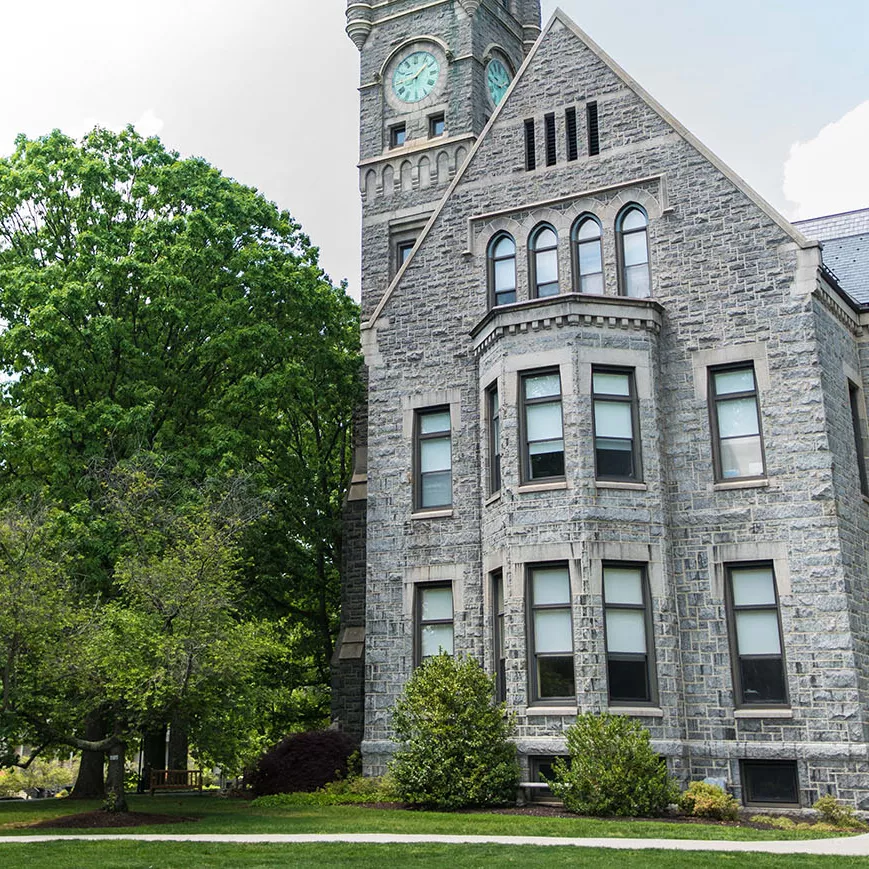
Office of the Provost
Contact Us
Taylor Hall, First Floor
Bryn Mawr College
101 North Merion Avenue
Bryn Mawr, Pennsylvania 19010 Email:Officeoftheprovost@brynmawr.edu Phone: 610-526-5167
Office Hours
Monday-Friday 8 a.m.-5 p.m.