
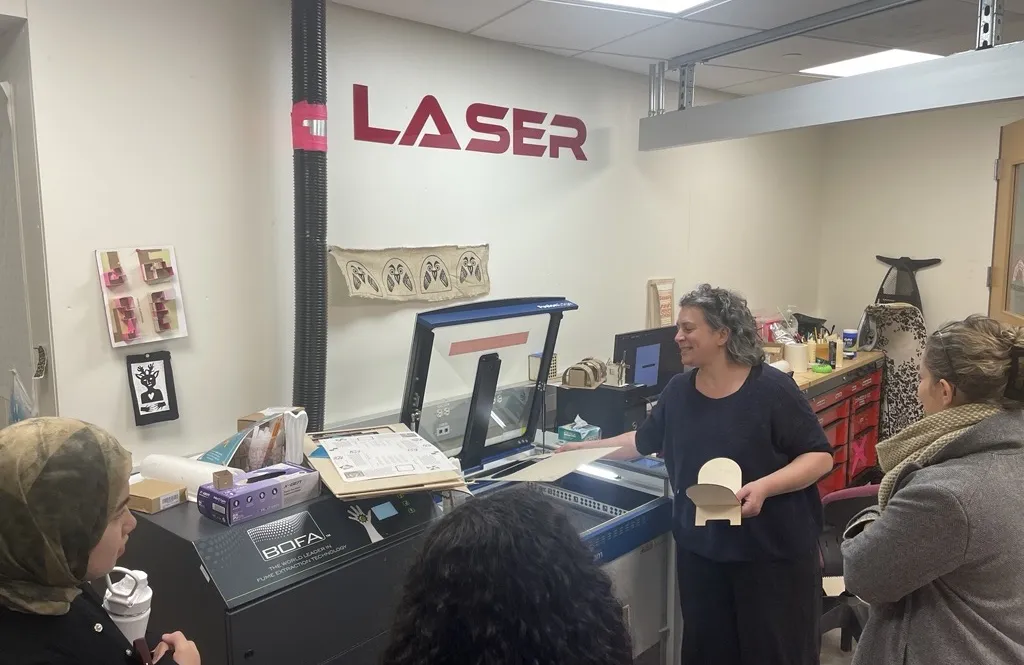
Last month, the Impact Center and Bryn Mawr's Makerspace teamed up to hold a workshop where students could make their own Qu'ran book rests, known as "rehals." The workshop was a collaboration between Makerspace Coordinator, Bronwen Densmore, and Soaad Elbahwati, Assistant Chaplain for Interfaith Life. During the workshop, attendees learned how to design their rehals in Adobe Illustrator and then print them on the Makerspace's laser cutter. Ultimately, everyone who came was able to take their rehals home.
For Elbahwati, the workshop was a chance to blend passions. Although she now works as a spiritual advisor to students, she is also an alum and former employee, specifically having worked in the Makerspace with Densmore. "The Makerspace challenged me to think expansively about creation, blending academic and creative support for students," she said. "I think religious and spiritual life can be very expansive in holistic application, so I was eager to create an opportunity for students to blend faith and spirituality with critical making – opening doors to various resources on campus in the same space." When she suggested the workshop idea to Densmore, the latter jumped at the opportunity. "The ways that we create and interact with the objects in our daily lives is a meaningful part of cultural experience. In this workshop, students were invited to use technical skills and make creative choices to construct an object that supports, protects and displays a sacred text. Approaching a project like this is a tactile and immediate way of caring and interacting with objects that carry meaning."
Attendees worked over the course of two hours to create and perfect their designs. "We discussed ways that different material choices would determine tool selection, demonstrated how to lay out and prepare a file for cutting, and worked with geometry that would allow us to make book rests that provide stability for books to be displayed in open or closed positions," Densmore said. Although laser cutters can handle a range of materials, from cardboard to acrylic, attendees made their rehals out of wood. Doing so let them make final products with real sophistication. "Attendees utilized Adobe stock to personalize their own rehal and created a truly unique piece," Elbahwati said. Going forward, she wants to do more collaborations with the Makerspace. "I’m hoping to host more events throughout the school year to cultivate diverse religious and spiritual expression and show that this can be integrated in different parts of their campus life. An idea I hope to see through is facilitating a workshop for students to create their own hand-dyed hijabs."
If community members are interested in using the laser cutter for their own projects, they can stop by the Makerspace during open hours. The schedule, as well as links for booking an appointment, can be found on the Makerspace website. Those with access to Moodle can also learn more about the laser cutter on the Makerspace Training page.